Blocking a website used to be a blacklist: the network sees you ask for a banned address and says "no." Deep Packet Inspection (DPI) is the grown-up version. It doesn't just read the address on the envelope — it reads the shape of your traffic. That's why a proxy or VPN can work one day and mysteriously die the next.
Who runs DPI — and what it sees
DPI isn't exotic. Two groups run it constantly:
- Governments, for censorship — inspecting traffic at a country's network borders to detect and throttle VPNs, proxies and circumvention tools.
- System & network admins — ISPs, universities and corporate IT — shaping, logging or blocking traffic on their networks.
Conventional inspection only reads the header — where a packet is going. DPI looks inside: the payload, the TLS handshake, packet sizes and timing, and protocol signatures.
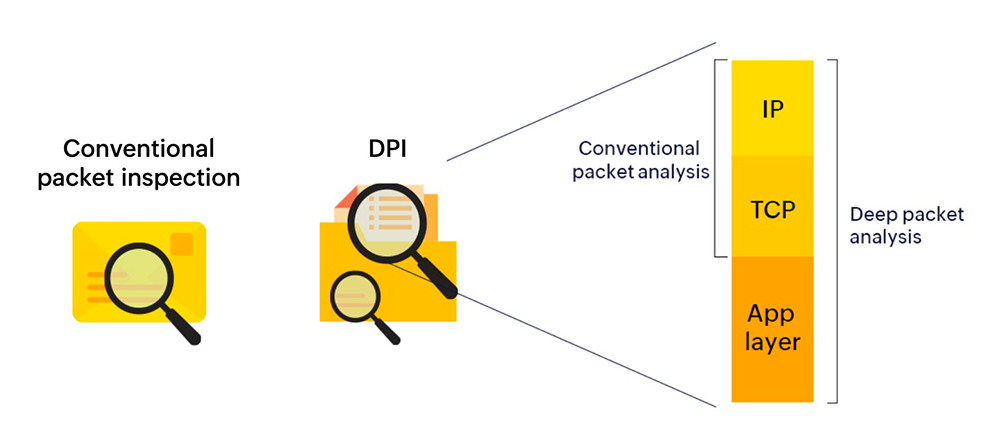
The tell is usually the protocol signature. Many tunnels announce themselves in their very first bytes. Once DPI learns that signature, it drops everything that matches — no blocklist required.
Why OpenVPN and WireGuard get caught
Here's the trap people fall into. OpenVPN, WireGuard and IPSec have fine encryption — but recognisable traffic. DPI doesn't break the crypto; it simply recognises "this is OpenVPN" or "this is WireGuard" and cuts it. Reaching for a bigger, more famous VPN doesn't help when the whole problem is that it's identifiable.
The real move: change the signature, not just the cipher
So the point was never "encrypt with RC4." The actual game is to change the
protocol signature DPI sees from the outside — make the connection look like
ordinary web traffic instead of a VPN. This happens on a local client:
your app connects to localhost, the client wraps your data in an obfuscation
layer, and a matching server/relay on the far side unwraps it.
Tools that actually do this
Cloak
Cloak sits in front of something like OpenVPN. OpenVPN's encryption stays — Cloak's job is to hide OpenVPN's characteristic traffic: it rewrites packet metadata to make the stream look like normal web traffic, and it defends against active probing (where the censor pokes your server to test whether it's a VPN).
AmneziaWG
A different approach. Instead of rewriting WireGuard's cryptography, AmneziaWG changes the packet features DPI uses to fingerprint WireGuard — it alters handshake and data-packet headers, changes packet sizes, and can inject junk packets. That breaks the "this is definitely WireGuard" signature.
VLESS + REALITY
Used in heavy-censorship environments like Iran. The idea: to a DPI box or an active prober, your server should look like a normal TLS / web service, not a VPN. REALITY is built so that if it can't identify an authorised client, it hands the connection off to a real website:
Client
  │  (looks like ordinary TLS)
  ▼
Internet
  │
  ▼
REALITY server
  ├─ authorised client  →  tunnel
  └─ probe / stranger   →  a real website
The honest caveat (2026)
There is no "install this and it definitely works in Iran." Iran's DPI keeps evolving — recent measurements report REALITY, WireGuard and even TLS fragmentation being detected or blocked on some Iranian networks. Obfuscation is an arms race, not a settled solution, and what works this month can be flagged the next.
Where a clean proxy exit comes in
Obfuscation gets you out unseen; the exit IP decides whether the destination trusts you once you arrive. Datacenter ranges are public and easy to score as "not a real user," so even a perfectly obfuscated tunnel can land on an IP sites already distrust. This is exactly where a proxy is extremely effective:
- Residential proxies exit through real consumer devices — you look like an ordinary home user, because on the network you are one.
- Mobile proxies exit through carrier IPs shared by thousands of real phones, which are very hard to block wholesale.
Putting it together
Beating DPI is a stack, not a trick: obfuscate the signature (Cloak / AmneziaWG / REALITY) so you look like normal web traffic, use modern ciphers — never RC4 — and exit through a clean residential or mobile proxy so the destination trusts you. Skip the "just use a bigger VPN" reflex; it's the recognisability that gets you caught.
Proxysterr gives you the exit half done right: residential and mobile pools built for exactly this, paid with crypto, no KYC, no expiry on your data. Point your obfuscated tunnel at a Proxysterr endpoint and you get the clean, trusted exit that makes the whole chain work.